


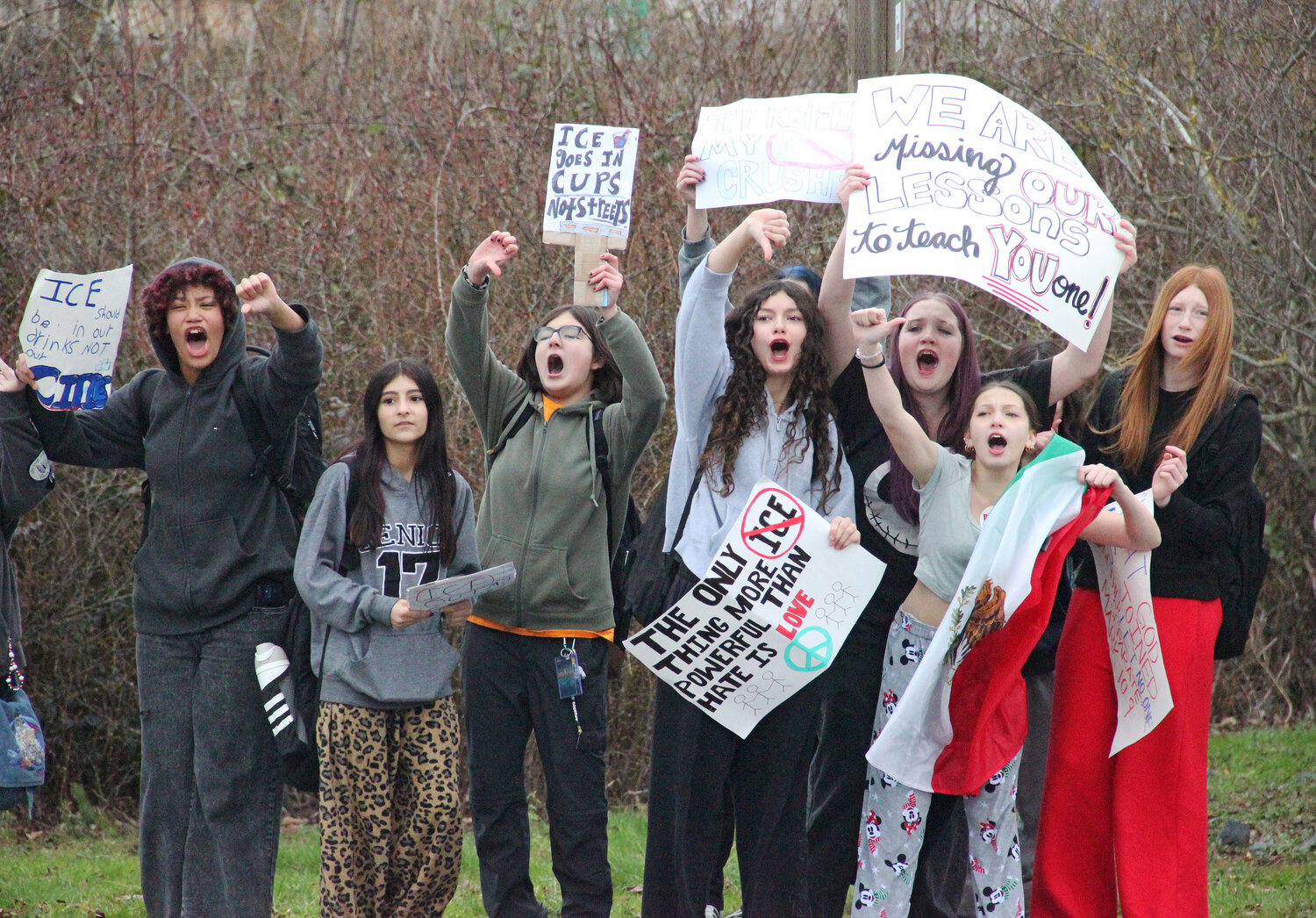


Dozens of Blaine students crowded four sidewalk corners along the U.S./Canada truck crossing, between U.S. Border Patrol’s Blaine station and the school district’s main campus on Feb. 12. The students, who had walked out of their afternoon classes to protest U.S. Immigration and Customs Enforcement, were joined by a handful of counterprotesters, a few adults and police monitoring from afar.
But before the text messages spread and posters were hung in the girls bathroom, there was an abandoned 2000 Chevy Malibu found on the side of I-5, just north of the Custer rest area, with keys left on the driver’s seat.
Juan Gonzalez-Hernandez, 41, moved with his family from Mexico to the Skagit Valley as a teenager. He attended Mount Vernon High School and considered northwest Washington home, eventually rearing three children and caring for others as if they were his own.
Family members described Gonzalez-Hernandez as a hard-working man who provided for his family. He worked in Bellingham and enjoyed helping an elderly man in Semiahmoo with household needs. Gonzalez-Hernandez volunteered at Blaine wrestling fundraisers and often left work early to take his three children, two of whom have nonverbal autism, to speech therapy. He was looking for a Spanish-speaking church to attend, family said.
Gonzalez-Hernandez moved to Washington from Camargo, Tamaulipas, a city known for cartel violence near the Rio Grande Valley in Texas. After a trip visiting Mexico in 2005, Gonzalez-Hernandez had attempted to cross the U.S./Mexico border, but was caught and sent back to Mexico. He returned to the U.S. the same day, family said.
On Feb. 3, nine days before the Blaine student walkout, Gonzalez-Hernandez was driving to work when Border Patrol stopped him on southbound I-5, near the Custer rest area. Gonzalez-Hernandez told family members that an undercover agent had followed him from Blaine before taking him to the Blaine Border Patrol station.
Blaine resident Marta Gallegos began receiving calls from Gonzalez-Hernandez’s family in Mexico who were worried about him after seeing missed messages from Blaine Border Patrol. Gallegos and her daughter, Abigail Gonzalez, went to Gonzalez-Hernandez’s work, only to find his employer had gone searching along I-5 for Gonzalez-Hernandez’s Chevy Malibu.
Gallegos hurried to the Blaine Border Patrol station to see if Gonzalez-Hernandez was there, but she said agents declined to disclose his location, citing safety reasons.
Aaron Pittman, special operations supervisor for Blaine Sector Border Patrol, wrote in an email to The Northern Light that he had prepared a response on Gonzalez-Hernandez’s detainment, but was unable to release it as he was awaiting approval from the U.S. Department of Homeland Security.
On the day of Gonzalez-Hernandez’s arrest, he was moved to ICE’s Northwest Detention Center in Tacoma. Gallegos was able to call Gonzalez-Hernandez on Feb. 4 at the Tacoma detention facility but quickly lost contact, which she believed was a result of him requesting a hearing in front of an immigration judge.
Gallegos submitted a bond payment request on Feb. 4 that was denied the next day. Soon after, Gallegos could no longer see Gonzalez-Hernandez’s location in the online database tracking detainees, despite later finding out that he was in Tacoma. She said she didn’t feel as if she was treated with respect and voiced concern that the system was purposefully made confusing with little resources.
“They say they’re not able to locate them in the system, even though they know they’re there,” Gallegos said. “It’s a shame because there are people who aren’t criminals, who are just working hard for their families, and they’re separating families.”
Most people detained by ICE have the ability to go before an immigration judge, but there is an exception for people placed in expedited removal. Examples of expedited removal include someone who has illegally reentered the U.S. after being removed, though U.S. law allows detainees with fears of persecution or torture in their home country to request a screening with an asylum officer.
The Executive Office for Immigration Review, the agency responsible for adjudicating immigration cases, has an online database that offers some case information, though not all cases are available. A search of Gonzalez-Hernandez’s information in the database did not yield any results.
Three days after being stopped on his way to work, Gonzalez-Hernandez was shackled by his hands and feet and transported to Mexico, where he arrived on Feb. 6. Gonzalez-Hernandez told family about seeing a man maced in the detention center and being around many people who appeared unhealthy, Gallegos said.
“He’s never done anything to be treated like an animal or to be deported,” Gallegos said. “He went to high school here. He should have rights. He should be able to appeal, but he never got that opportunity.”
The Northern Light repeatedly attempted to contact an ICE spokesperson with questions regarding Gonzalez-Hernandez being held in ICE custody at the Northwest Detention Center, including whether Gonzalez-Hernandez requested a hearing before an immigration judge, why he was transported to Mexico and verification of the dates when he was in the agency’s custody.
An ICE spokesperson, who did not provide their name, responded, “You’ve reached ICE. Please reach out to CBP for a CBP arrest.”
Gallegos’s daughter, Gonzalez, said Gonzalez-Hernandez wasn’t able to get through a sentence describing his experience being detained without crying.
In an attempt to protect her 7-year-old brother, Junior, Gonzalez said she and her mother told him that Gonzalez-Hernandez was on a work trip.
“Every single day he was saying, ‘I miss dad. I miss dad. When is he going to come back?’” Gonzalez said. “The other night he said, ‘I think dad just doesn’t want to be here anymore. He just doesn’t want to come home.’”
Gonzalez-Hernandez’s employer has hired an attorney to try to fight the case. In the meantime, Gallegos said she’ll now need to rely on Gonzalez to help care for the younger children, including taking them to speech therapy appointments.
Gonzalez began designing posters, reaching out to friends and sharing the word about an anti-ICE student walkout she was organizing for Feb. 12.
“I didn’t see anyone doing it,” Gonzalez said of a school protest. “But when this happened, I finally got the courage to do it, even though it was scary.”
Dozens of Blaine high school and middle school students left their afternoon classes on Feb. 12 and positioned themselves with signs around the U.S./Canada truck crossing that read, “we are missing our lessons to teach you one,” “the only thing more powerful than hate is love” and “we are America together.” Gonzalez led chants, while students cheered loudly for honking drivers and some booed drivers with expletives who didn’t support their message.
A handful of students formed their own counterprotest as a way to support ICE and the U.S., they said. The counterprotesters held their American flags high and displayed signs that read, “We support ICE. Deport them all.” Some protesters would swarm and loudly berate their classmates who supported ICE, causing the counterprotesters to find new areas to display their beliefs.
Junior Luke Berkeley said he was inspired to counterprotest because he wanted to support his country. He said he agreed that people should be able to move to the U.S., but it needed to be done legally, just as his parents had done when immigrating from Canada.
“We need to get rid of the illegals,” Berkeley said. “Not in a bad way, but getting rid of them so they’re not hurting our country.”
Berkeley said he was struggling to find a job in Blaine because the jobs were being taken by people who had illegally entered the country.
“Don’t let the illegals take over,” he said.
Other counterprotesters, who declined to be interviewed, said they wanted to support law enforcement and their ability to enforce the law.
About 30 minutes into the protest, a woman showed up with a large Trump 2024 flag that she displayed while walking back and forth on the crosswalk. A group of protesters crowded the woman and shouted at her as she continued walking with her flag, which quickly led to an altercation.
The woman left the dispute and was followed by students as she walked over to Blaine police officers monitoring the protest. She continued to wave her Trump flag as Blaine officers took recounts of what happened.
Blaine Police Chief Rodger Funk said students reported the woman assaulted them, but after reviewing video, it appeared the woman’s flag was grabbed and any contact was incidental. Police later escorted the woman from the protest.
Many student protesters said they wanted to stand up for what they believed was right. Others said they wanted to be a voice for classmates who remained in class, scared their participation could affect their families at risk of being deported.
For eighth grade student Genesis Herrera, the walkout was a way to have a voice after unsuccessfully asking school counselors to organize an assembly sharing resources on national immigration policies.
“In our school, there are a lot of MAGA and pro-ICE students. There are students, when people try to speak up, who will say, ‘What ICE is doing is right,’” Herrera said. “I think students may be afraid of humiliation or to be embarrassed, and scared to reach out because their voices aren’t heard.”
Herrera said students have relied on each other and trusted educators to receive resources and process what they’re seeing in national news. Students are having conversations every day with their peers, which has led to some friendships ending, Herrera said.
“I have distanced myself from friends who support that stuff,” Herrera said. “It’s hard not to involve politics going to school every day. If you think about it, everything is political.”
Blaine Superintendent Dan Chaplik said while he preferred students stay in class, he understood their right and desire to speak on issues they felt strongly about. He said the district’s role is to help students solve their problems, not to be political.
“It is a challenging set of circumstances for everyone,” Chaplik said. “As a school system, we are neutral and we care about every student, regardless of their religion, race or political beliefs. We’re here to serve everyone in our community, so we help students engage in discussions about various things. But if we’re doing our job right, they don’t know where we stand on issues, and that’s the way I believe it should be.”
As for Gonzalez, she said her classmates who attended the protest didn’t know about her family’s experience the week prior. The high school senior didn’t tell anyone before the protest, save for one friend and a wrestling coach, because she didn’t want to be pitied. But then her friend gave her some advice.
“My friend said, ‘What happened to Juan, that’s a story to tell,’” Gonzalez said. “It’s important for people to know. That’s why I’m sharing this, so more people can grasp what’s actually happening.”